Blog >> Article Details

01 April, 2026
Factory Production Lines: How to Choose the Right System for Your Plant?


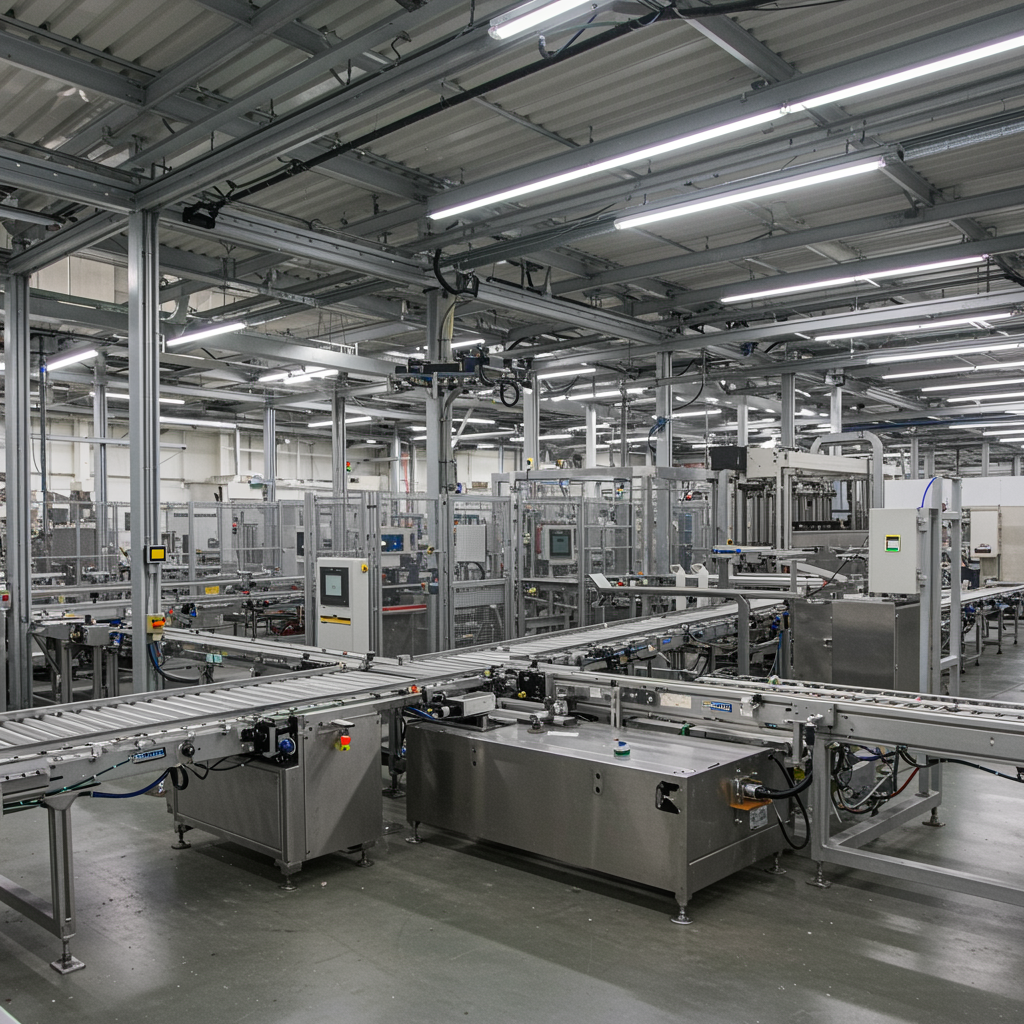
Today, production lines are an essential part of improving operational efficiency, enhancing product quality, and reducing wasted time between different manufacturing stages. The better a production line is designed, the smoother and faster materials and products move between processes, leading to better organization inside the factory and fewer stoppages or losses.
The role of production lines is not limited to speeding up operations. They also help optimize space utilization, reduce dependence on manual handling, and improve workplace safety. That is why choosing the right production line has become a strategic decision for any factory seeking growth, modernization, or higher daily performance.
What Are Factory Production Lines?
Factory production lines refer to the integrated system that connects the various stages of manufacturing within a facility, starting from raw material intake, passing through handling, transportation, assembly, or packaging, and ending with the finished product ready for delivery.
The components of a production line may differ from one factory to another depending on the nature of the industry, but the main objective remains the same:
to achieve an organized and smooth flow of materials and products inside the factory with the highest possible efficiency.
Why Do Factories Need Efficient Production Lines?
Having an efficient production line does not simply mean moving products from one point to another. It means creating a more stable, organized, and productive manufacturing process. The main benefits of well-designed production lines include:
1) Improved Operational Efficiency
When product movement inside the factory is organized, delays between production stages are minimized, and workflow becomes faster and more consistent. This directly increases the plant’s daily production capacity.
2) Reduced Waste and Damage
Manual or poorly organized handling often leads to product damage, falling items, or contamination, especially in sensitive industries. Properly designed production lines help protect products while they are being transferred.
3) Better Use of Available Space
Some factories struggle with limited space or poor equipment layout. In such cases, a well-designed production line makes the best use of available space without disrupting workflow or making maintenance difficult.
4) Lower Operating Costs
When factories reduce manual handling, minimize unplanned downtime, and improve process speed, operating costs decrease significantly over the medium and long term.
How to Choose the Right Production Line for Your Factory
Choosing the right production lines is not only about appearance or cost. It requires a clear understanding of the production process inside the factory. There are several essential factors to consider:
Product Type
The first question to ask is: what exactly will be transported on the production line?
There is a major difference between moving lightweight packages, bulk raw materials, food products, glass containers, or heavy metal parts. Each product type requires a suitable handling system in terms of material, belt surface, speed, and guiding mechanism.
Operating Environment
The factory environment itself is a critical factor in choosing the right production line.
For example, food factories require systems that are easy to clean and compliant with hygiene standards, while metalworking or high-temperature industries may require conveyors that can withstand harsh conditions or elevated temperatures.
Some of the conveyor solutions shown on the website are suitable for such varying needs, including slat conveyors, modular belt conveyors, roller conveyors, wire mesh conveyors, and spiral conveyors. This clearly shows that selecting the right line should be directly linked to product type, operating environment, and available space.
Available Factory Space
Not every factory has the same مساحة or floor layout. That is why the production line should be designed to maximize the use of the space available without complicating movement or maintenance.
An Important Example:
If floor space is limited, a vertical or spiral solution may be more suitable than a long horizontal layout, as it saves space while maintaining efficient product flow.
Required Production Speed
Before implementing any production line, the target production rate must be clearly defined:
How many units need to be transported, processed, or packed per hour?
The answer to this question affects:
-
Conveyor speed
-
Line width
-
Motor type
-
Load capacity
-
Number of transfer or collection points
Ease of Maintenance and Future Expansion
A good production line is not only one that performs efficiently today, but one that can also be maintained easily and expanded later if production increases. For this reason, flexible solutions that allow upgrades or additions without replacing the entire system are always preferred.
Key Components of a Successful Production Line
For a production line to deliver the best performance, several elements must work together effectively:
Accurate Engineering Design
Every successful production line begins with a proper study of product flow, loading and unloading points, and the type of movement required between production stages.
High Manufacturing Quality
No matter how strong the design is, it will not deliver the desired results if materials or manufacturing quality are poor. Durability, precision in execution, and the quality of components are all critical to the line’s efficiency and service life.
Proper Installation and Commissioning
Installation is just as important as design and manufacturing. Correct alignment, system testing, and ensuring that the line integrates smoothly with the factory environment all directly affect final performance.
Technical Support and Maintenance
A proper maintenance plan and fast technical support reduce unexpected breakdowns and help keep operations stable over longer periods.
This is consistent with how El Masrya presents its services on the website, combining engineering design, in-house manufacturing, installation and commissioning, maintenance and technical support, and custom solutions into one integrated service cycle for production lines.
When Do You Need to Upgrade Your Existing Production Line?
A factory may not always need a completely new production line. In many cases, upgrading the current system is enough. The clearest signs that indicate the need for improvement include:
-
Frequent operational stoppages
-
Slow product movement between stages
-
High waste or damage rates
-
Difficulty expanding production
-
Heavy reliance on manual handling
-
Poor use of available space
If one or more of these issues occur repeatedly, it is likely time to reassess your existing production line and choose a more efficient solution.
Custom Production Lines Based on Industry Requirements
Not all factories are the same, which means there is no one-size-fits-all solution. Food industries, for example, require hygienic and precise conveying systems, while packaging lines need smooth and controlled product flow, and heavy-material industries require systems with greater load capacity.
The website also presents practical solutions for different sectors, including food industries, with systems for raw material transport, product lifting, and connecting mixing, forming, and packaging stages. This highlights the importance of designing each production line according to the actual needs of each industry.
Conclusion
Choosing the right production lines for your factory is not a simple operational decision. It is a direct investment in efficiency, quality, and business continuity. The more the line is designed based on a real understanding of the product, available space, operating environment, and production rate, the better the results will be in terms of performance and cost.
So, if you are planning to upgrade your factory or improve workflow inside it, start by understanding your actual operational needs, then choose the engineering solution that gives you the best balance between speed, durability, easy maintenance, and future scalability.
Looking for the Right Production Line Solution for Your Factory?
If you are planning to upgrade an existing line or implement a new one that fits your product type and factory space, choosing a partner with expertise in design, manufacturing, installation, and maintenance can help you achieve a practical and reliable long-term result.


